What is an option? Calls and Puts through a house-deposit contract
What you will learn
Drop the gambling stereotype. Use a deposit and an insurance policy to see the premium and contract logic behind Calls and Puts.
Options are not gambling
The first time many people hear “options,” two pictures jump in: someone turning a small stake into a fortune in a few days, or an account going to zero overnight. So options get called a legal casino.
That mixes up the tool with the use. A hammer can build a house or smash a window. An option itself is a standardized contract: the buyer pays a fee set in advance, and in return gets the right — not the duty — to buy or sell an asset at an agreed price before a set date. The seller collected that fee, so when the buyer chooses to exercise, the seller has to perform.
Institutions use the same contract for two boring, important jobs: hedging risk they already hold, and collecting the money other people will pay for uncertainty. Betting on direction is only one use of the same contract, not its definition.
This lesson skips pricing formulas and trading software. Two everyday agreements — a house deposit, and crop-price insurance — are enough to plant the intuition for Calls and Puts. Every later lesson sits on that intuition.
Takeaway: Options trade rights and obligations, not a bet on up or down.
The Call: lock in a buy price with a deposit
Suppose a house is listed at $1,000,000. You think the neighborhood will re-rate — a subway stop opens in three months, and the price could be $1,300,000. You don’t have a million in cash today, and you don’t want to lock all of your capital into this house right now.
So you go to the owner and sign an agreement: “I’ll pay you $50,000 as a deposit. For the next three months, no matter how high the market goes, I have the right to buy this house at $1,000,000. At expiry I can buy — or walk away.” The owner agrees. The contract is on.
What you bought is not the house. It is a choice. If prices really rise, you buy; if they fall, you don’t. The owner cannot back out. You can. That is the asymmetry of right versus obligation.
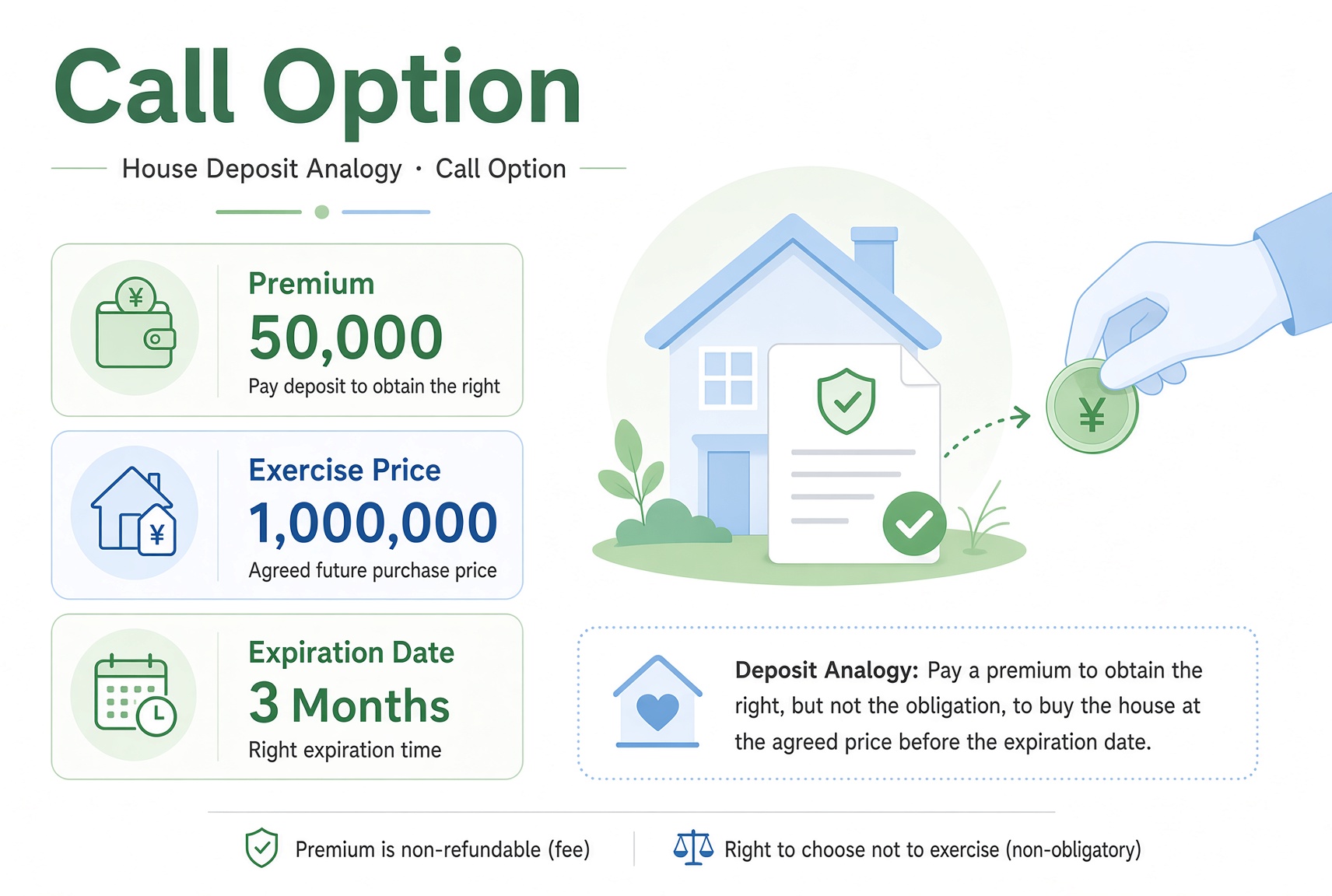
In market language, that contract is a call option. Four names on the same piece of paper:
The $50,000 deposit is the premium — the price of the right. Whether you later exercise or not, that money usually stays with the seller.
The agreed $1,000,000 purchase price is the strike.
The three-month window is expiration. After that day the right dies.
The house is the underlying.
In one line: a Call is a right you paid for — to buy an asset later at a fixed price. You have no duty to buy.
Takeaway: A Call is the right to buy later at a fixed price. You buy it when you think the asset will rise.
Two outcomes: leverage and a hard loss cap
Three months later, two typical paths. Run the numbers and the Call buyer’s payoff shape is set.
The house is worth $1,300,000. You exercise: buy at $1,000,000, sell at $1,300,000. The $300,000 gap minus the $50,000 premium is a $250,000 net profit.
Compare:
You put up $50,000 and made $250,000 — a 500% return.
Had you paid $1,000,000 cash for the house, the same move is only 30%.
That is leverage: a smaller stake moving the whole asset’s gain.
The house is worth $800,000. Nobody buys an $800,000 house for $1,000,000. You let the right expire. You lose the $50,000 premium — and nothing more. You do not owe the owner, and you do not eat the $200,000 drop from 1,000,000 to 800,000.
Up moves can pay a lot. Down moves are capped at the premium. That “loss has a ceiling, gains can be large” shape is the Call buyer’s core.
Takeaway: A Call buyer spends a known, limited risk (the premium) for a larger upside. If the direction is wrong, the loss still stops at the premium.
The Put: lock in a selling price with insurance
A Call locks in a buy price. If you already hold an asset and fear a drop — or you are simply short the market — you need a floor on the selling price. That is a put option.
You farm wheat that will be harvested in three months. The market is $100 a bag. A bumper crop could dump the price to $60 and wipe out the season. You pay a grain dealer $5 of premium for this deal: three months from now, no matter how low the market, you may sell at $100. The dealer took the premium, so they must take the wheat.
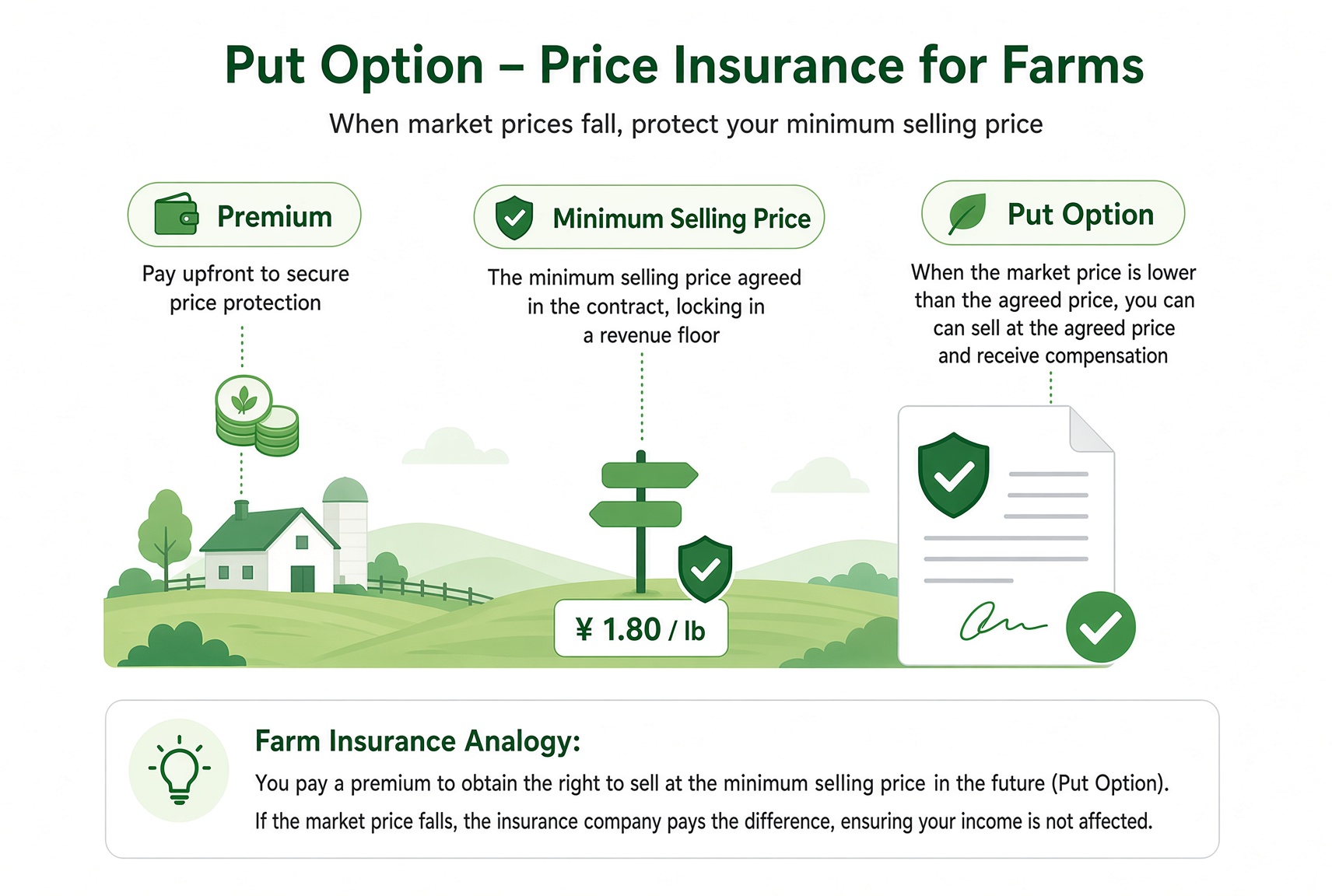
The market is $60. You exercise and sell at $100. After the $5 premium, you have locked in about $95 and skipped the drop from 100 to 60.
The market is $150. You will not sell to the dealer at $100. You sell in the cash market at $150 and lose only the $5 premium. You still own the rally; you still have a floor on the way down.
Two uses, one right:
You hold the asset and fear a drop: the Put is price-drop insurance.
You do not hold the asset and expect a drop: buying a Put is a limited-cost short.
Takeaway: A Put is the right to sell later at a fixed price. You can use it to bet on a decline, or to insure something you already own.
Buyer and seller: rights and duties swap
You now have two options: a Call is the right to buy, a Put is the right to sell. The market also has sellers. The owner who took your $50,000 deposit is the Call seller. The dealer who took the $5 premium is the Put seller. There is no option with a buyer and no seller.
Two sentences are enough:
Buyer (long): pays for a right, has no duty to perform. Worst case is the full premium. Calls pay when the asset rises; Puts pay when it falls.
Seller (short): collects cash and takes the duty. Best case is the premium received. If price runs the buyer’s way, the seller must buy or sell at the strike, and the loss can dwarf that premium.
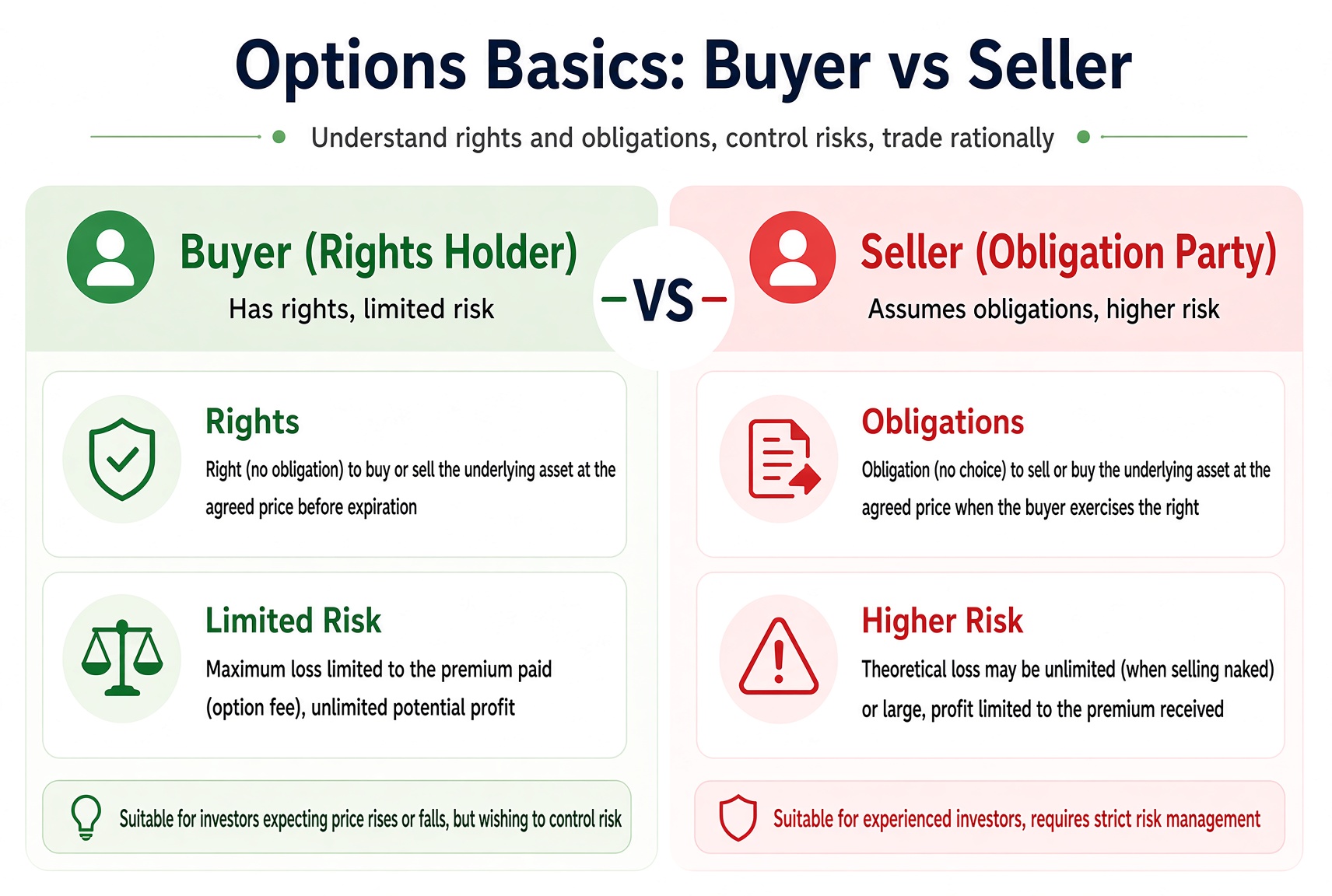
Why do so many institutions sell? A large share of options expire with the underlying nowhere near a useful exercise. The right dies; the seller keeps the premium. Time passing and prices chopping around are, on average, kind to the party collecting insurance — like an insurer. A violent move the other way can still hurt, so real sellers hedge. They do not sell naked.
If you are new, learn the buyer’s logic first, then the seller’s. A buyer’s loss has a ceiling, so the shape is easier to see. Covered Calls, cash-secured Puts, and spreads later in the course are all ways to put constraints on the seller.
Takeaway: Buyers pay for a right; losses are capped. Sellers collect cash and take a duty; the risk is higher. Start on the buy side.
Wrap-up, next: the option chain
Translate the household contracts back into market language:
An option is a standardized contract. What is bought and sold is a right to buy or sell later at an agreed price — not a duty.
A Call locks in a buy price: you are bullish, or you want upside with limited cash.
A Put locks in a sell price: you insure a holding, or you are bearish.
The money you pay for the right is the premium; the fixed price is the strike; the last day the right lives is expiration.
Buyers pay for a right; losses are capped. Sellers collect cash and take a duty; risk is higher.
The one sentence to keep: An option is a right, not a duty. The buyer may use it or not. The seller must perform.
In a real brokerage app those contracts are laid out as a dense table: the option chain. Each cell is a specific Call or Put — different expirations, different strikes, bid and ask. A lot of first losses are not a wrong direction. They are a misread of the numbers in the grid.
The next lesson takes that table apart. This lesson is done when you can say, in your own words, what a Call is, what a Put is, what premium, strike, and expiration mean, and which side of the contract the buyer and seller sit on.
The two paths, using this lesson’s house numbers
A 50,000 deposit locks a 1,000,000 buy. Same numbers as the lesson — no new visual language.
1,300,000
- Buyer’s choice
- Exercise: buy at 1,000,000
- Buyer P/L
- +250,000
Check these three first
Pass these three before the next lesson. You can skip.
1.Once the Call buyer pays the deposit, they must buy the house at expiry.
2.The premium is usually kept, whether the buyer exercises or not.
3.The seller who collected premium must perform if the buyer exercises.