How is an option priced? Intrinsic vs. extrinsic value and time decay
What you will learn
See that premium = intrinsic + extrinsic, understand time decay, and avoid being right on direction and still losing money
Start with one formula
The last two lessons covered what Calls and Puts are, and how to read an option chain. Before you actually place an order, there is a more basic question: how is the option’s price — the premium — set? Why can the stock go up and your Call still sit still, or even lose money?
An option’s price (the premium) has two parts:
option price = intrinsic value + extrinsic value
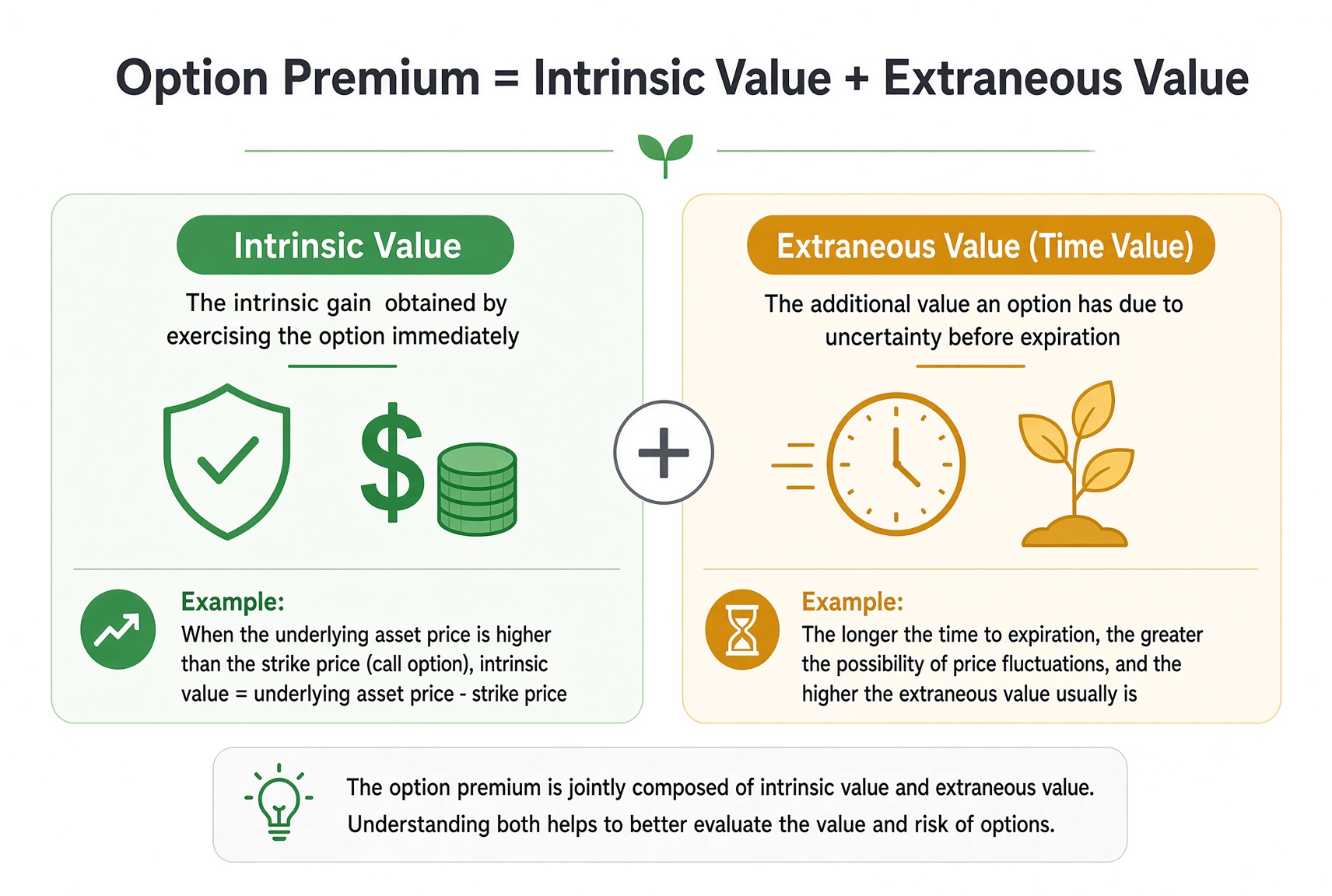
Extrinsic value is usually also called time value. This formula runs through every options trade. Once you see it, you can explain why “the direction was right and the account still lost.”
Takeaway: Premium is not driven by the stock’s move alone. It is “what it is worth now” plus “what it might still be worth later.”
What intrinsic value is
Intrinsic value is: if you exercised right now, how much would this option be worth.
Example: Apple trades at $150, and you hold a Call with a $140 strike. Exercise now, buy at 140, sell in the market at 150, and you pocket $10. That $10 is real intrinsic value.
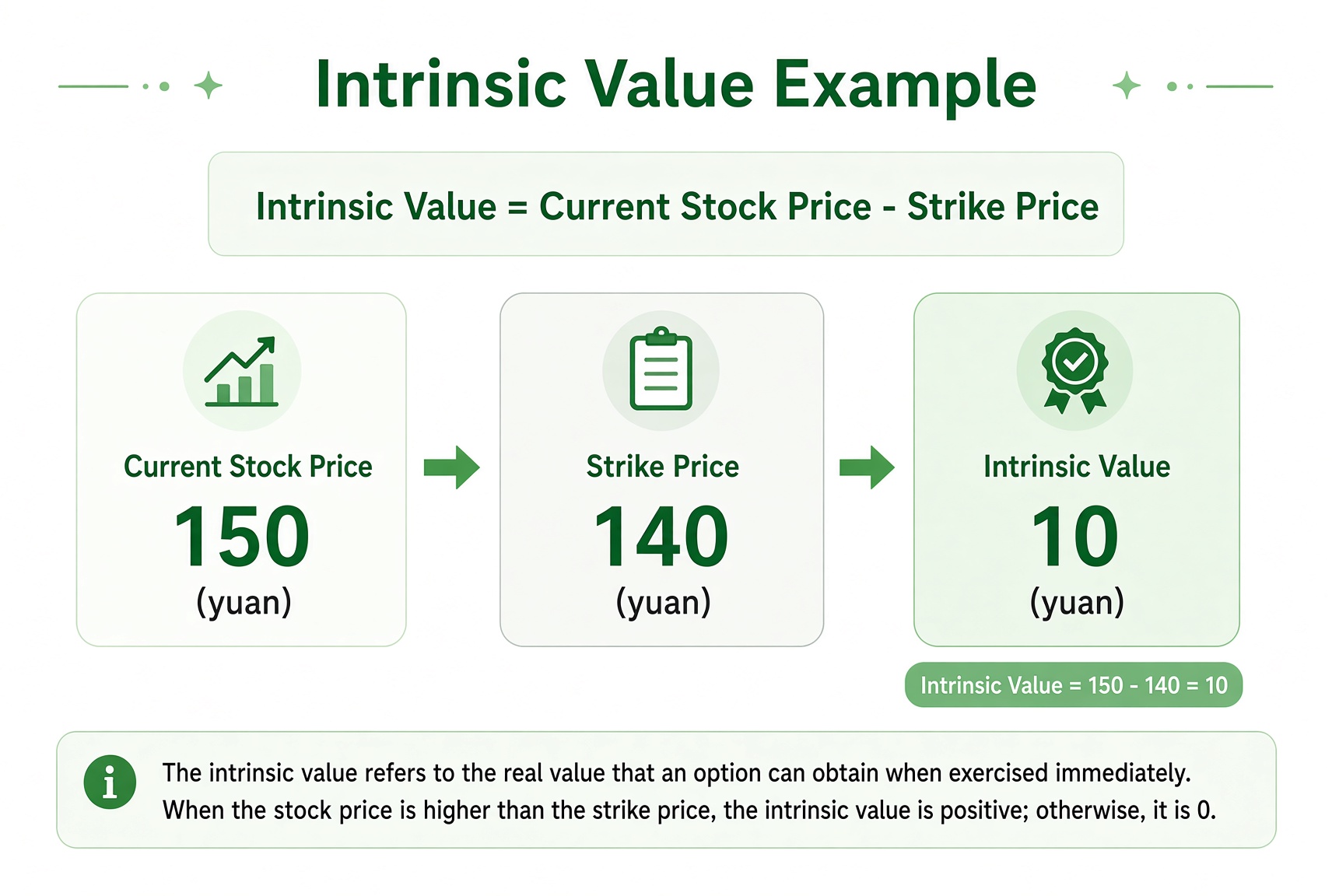
If the strike is $160 (above the current stock price), exercising now does nothing useful. Intrinsic value is 0.
Puts reverse the arithmetic: a Put has intrinsic value only when the strike is above the current stock price.
Takeaway: Intrinsic value = the money you would make by exercising now. If there is none, it is 0 — never negative.
What extrinsic value is
Even when exercising now would make nothing (intrinsic value is 0), the option usually still has a price. That leftover price is extrinsic value, also called time value.
Why does time value exist? Because expiry is still ahead, and the stock still has a chance to move your way. The market will pay a little for that possibility.
Extrinsic value has a harsh physical fact: it is an ice cube in your hand. Every second it melts, and it does not freeze back. At the last moment of expiry day, every option’s extrinsic value goes to zero.
If the stock never reaches the strike by then, the whole contract is waste paper.
Takeaway: Extrinsic value is what the market pays for “not expired yet.” On expiry day, it always goes to zero.
Time decay is not linear
More important: time value does not melt at a constant speed. The curve is nonlinear:
With 90 to 60 days left, the ice melts slowly.
Inside 30 to 45 days, it speeds up.
In the last week (especially into expiry day), time value evaporates faster.
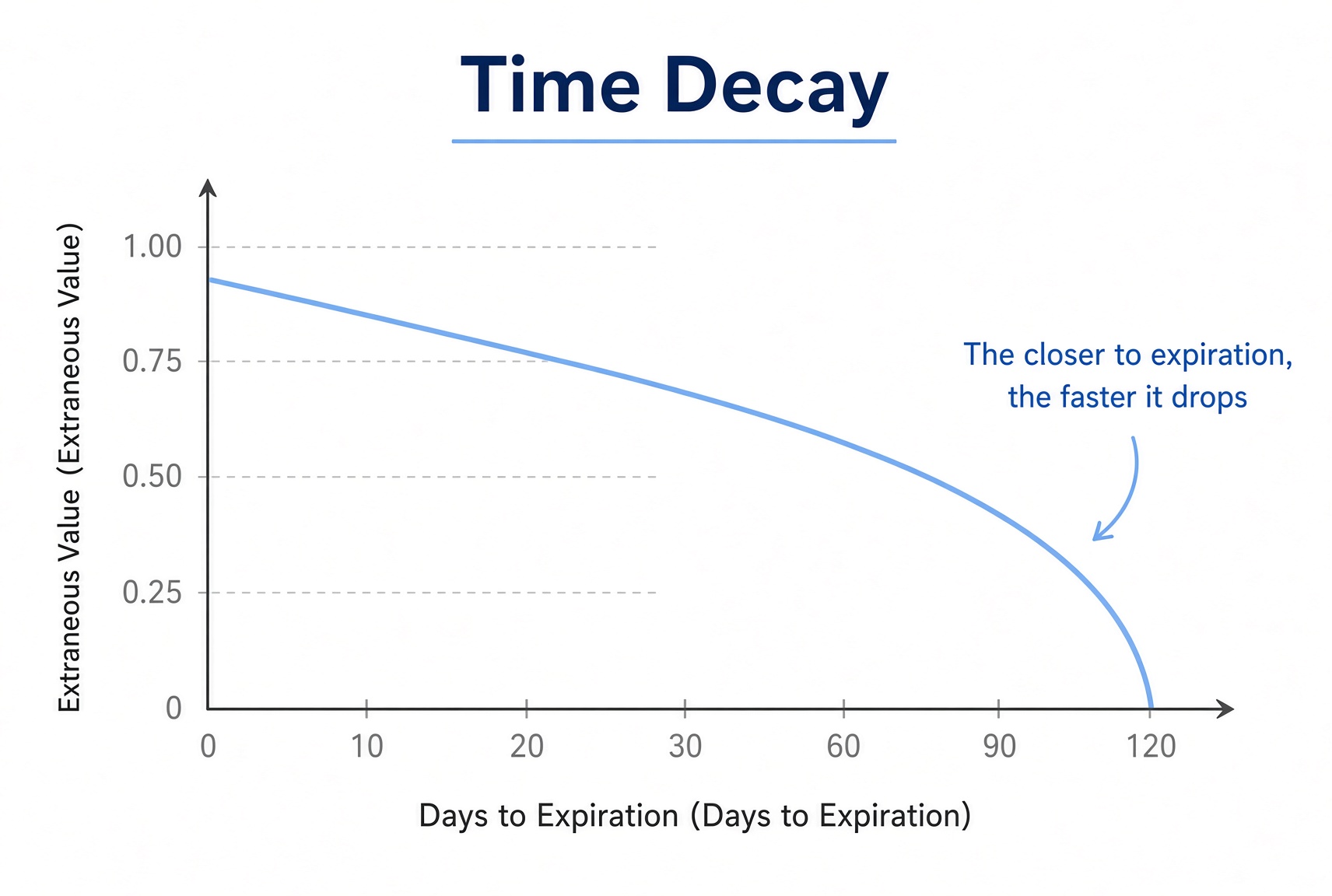
That is why people who buy options with only a few days left often see a small stock rally fail to cover the time value that disappeared.
Takeaway: For the buyer, time is the enemy. For the seller, time is a friend. That is one of the reasons selling can feel like collecting rent.
Buyers and sellers sit on opposite sides of time
Once intrinsic and time value are clear, the buyer–seller game is clear too.
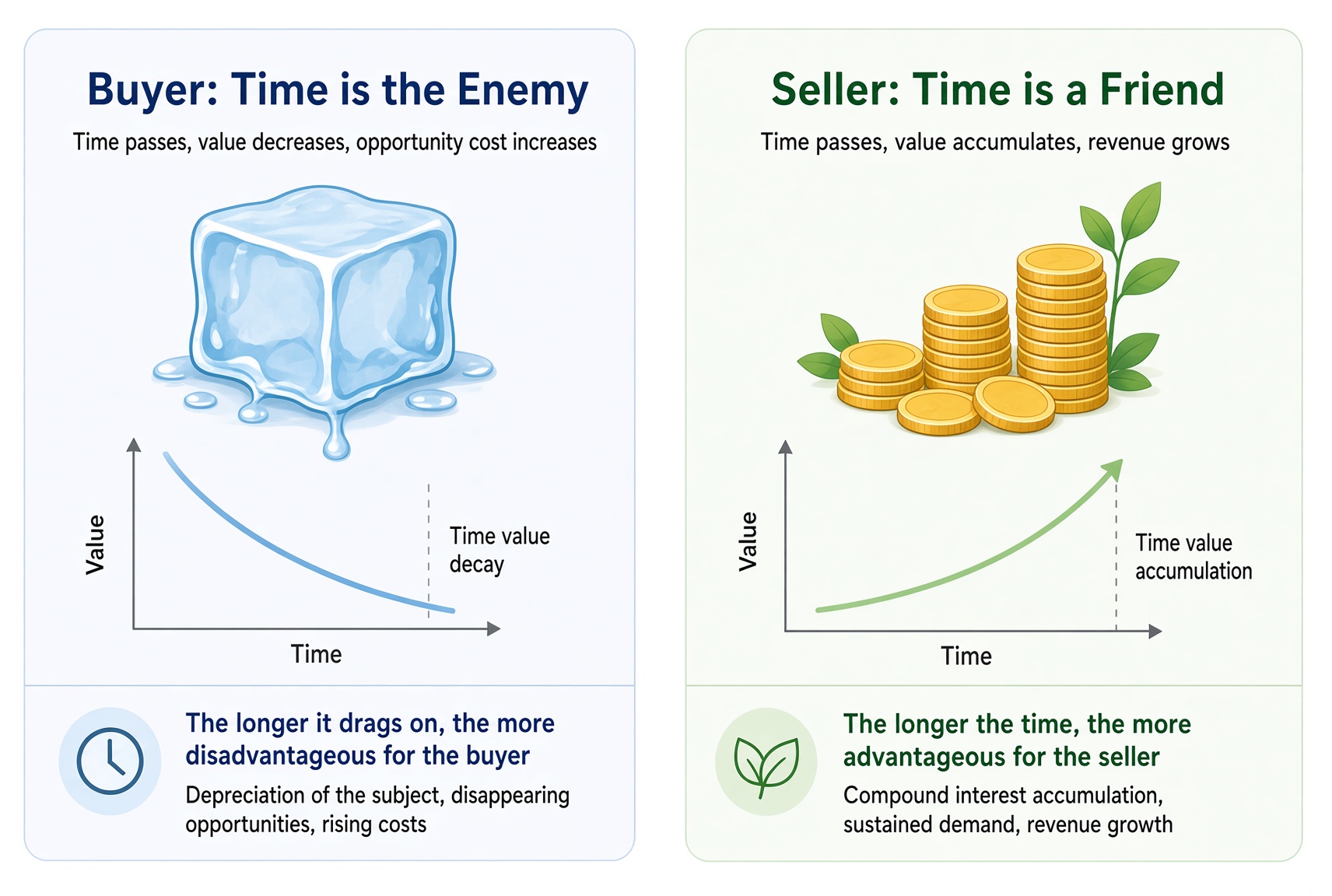
The buyer pays every day for time passing. Even if the stock does not move at all, the option can still lose money. So the buyer needs the stock to move in their favor soon enough to cover that cost.
The seller is the other side: if the stock does not run hard against them, time decay becomes their profit. Selling an option is putting extrinsic value in your pocket; when the ice is gone, the premium stays.
Takeaway: Time passing is a cost for the buyer and income for the seller. Know which side you are on before you open the contract.
Right on direction, still losing money
Suppose you buy a Call when the stock is 100, strike 105, premium $3. A few days later the stock is indeed 103 — and your option has fallen from $3 to $2.20. Direction was right. The account still lost.
The reason is simple: intrinsic value went from 0 to a little, but extrinsic (time) value melted more, so the total premium fell.
A cleaner case: the stock does not move at all. Intrinsic value does not rise, time value still melts, and premium only goes down.
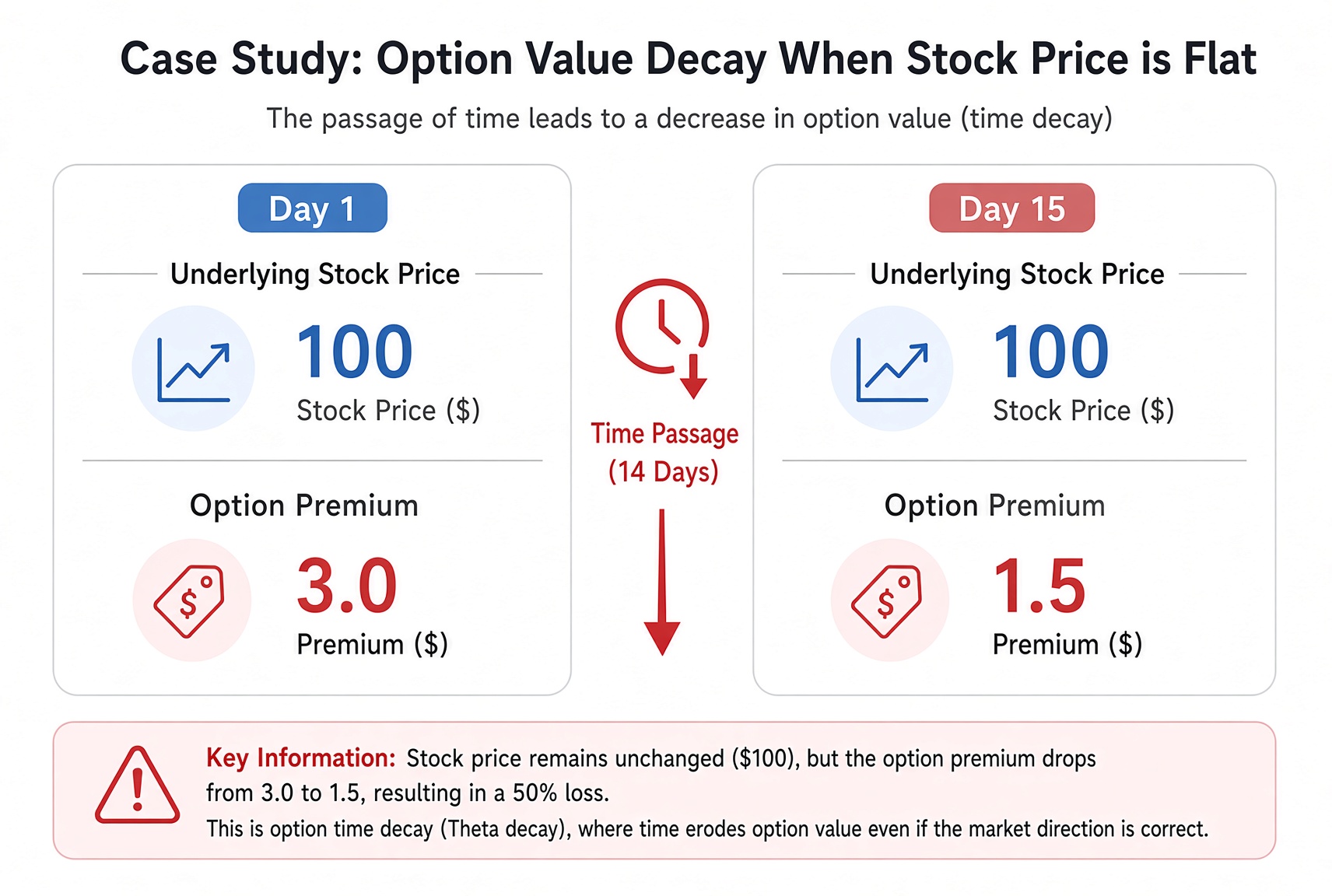
That is why watching direction and ignoring time value is a common way to get hurt in options.
Takeaway: The stock can go up and the option still not. Time value may be leaking out in the background.
Wrap-up, next lesson on settlement
Option price = intrinsic value + extrinsic value (time value).
Intrinsic is “how much exercising now would pay.” Extrinsic is “the possibility that time has not run out.”
Extrinsic value shrinks irreversibly with time, and faster as expiry nears. Buyers need time on their side; sellers get paid as it passes.
The one line to keep: The stock can go up and the option still not. Time value may be leaking out in the background.
With the price parts in place, the next practical question is settlement: what happens after expiry? What is exercise, what is assignment? Cash settlement versus physical delivery? The next lesson walks through those flows.
Check these three first
Pass these three before the next lesson. You can skip.
1.An option price splits into intrinsic value plus extrinsic (time) value.
2.Time value usually gets larger as expiry gets closer.
3.An out-of-the-money option has zero intrinsic value; its price is almost all time value.