Delta: not just a price coefficient — also a rough win rate
What you will learn
See Delta’s two jobs: how sensitive the option is to the stock, and the rough chance it finishes in the money
The “win rate” here is an approximation of finishing in the money at expiry, not the chance this trade makes money.
What Delta actually is
The last lesson covered expire-worthless, exercise, and assignment. From here we enter the Greeks. The name sounds intimidating; Delta is the most intuitive, and the most useful.
Delta measures: for each $1 the underlying moves, roughly how much the option price moves.
Example: a Call with Delta 0.60 means if the stock rises $1, that Call’s price rises about $0.60. One contract is 100 shares, so the contract gains about $60.
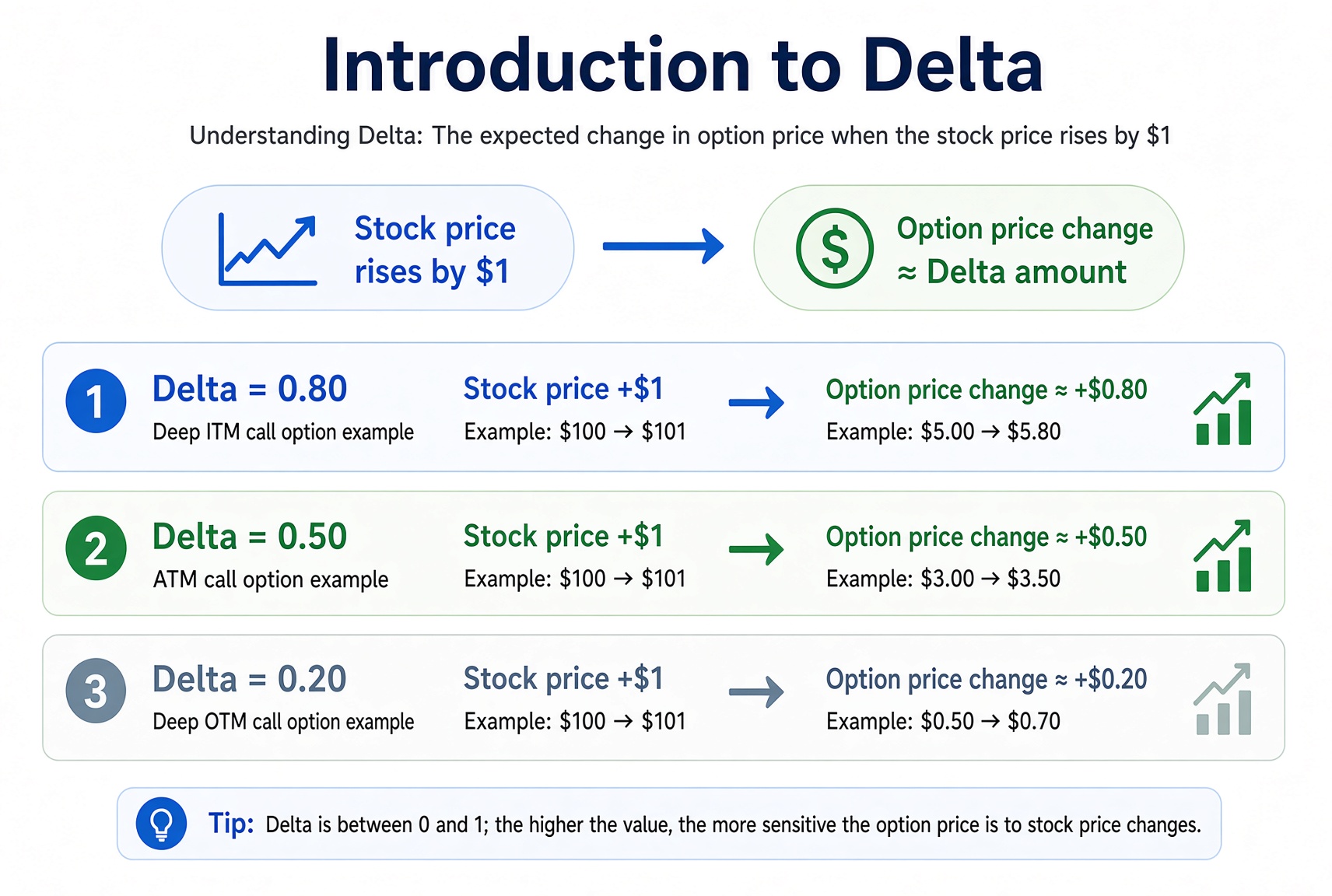
Call Delta sits between 0 and 1. Put Delta sits between −1 and 0, because when the stock rises, Puts usually fall.
Takeaway: Delta is how sensitive the option price is to the stock. It is dynamic — it changes with price and with time.
Delta as a rough win rate
A very practical rule of thumb: the absolute value of Delta is roughly the chance this option finishes in the money. People also call that ITM probability.
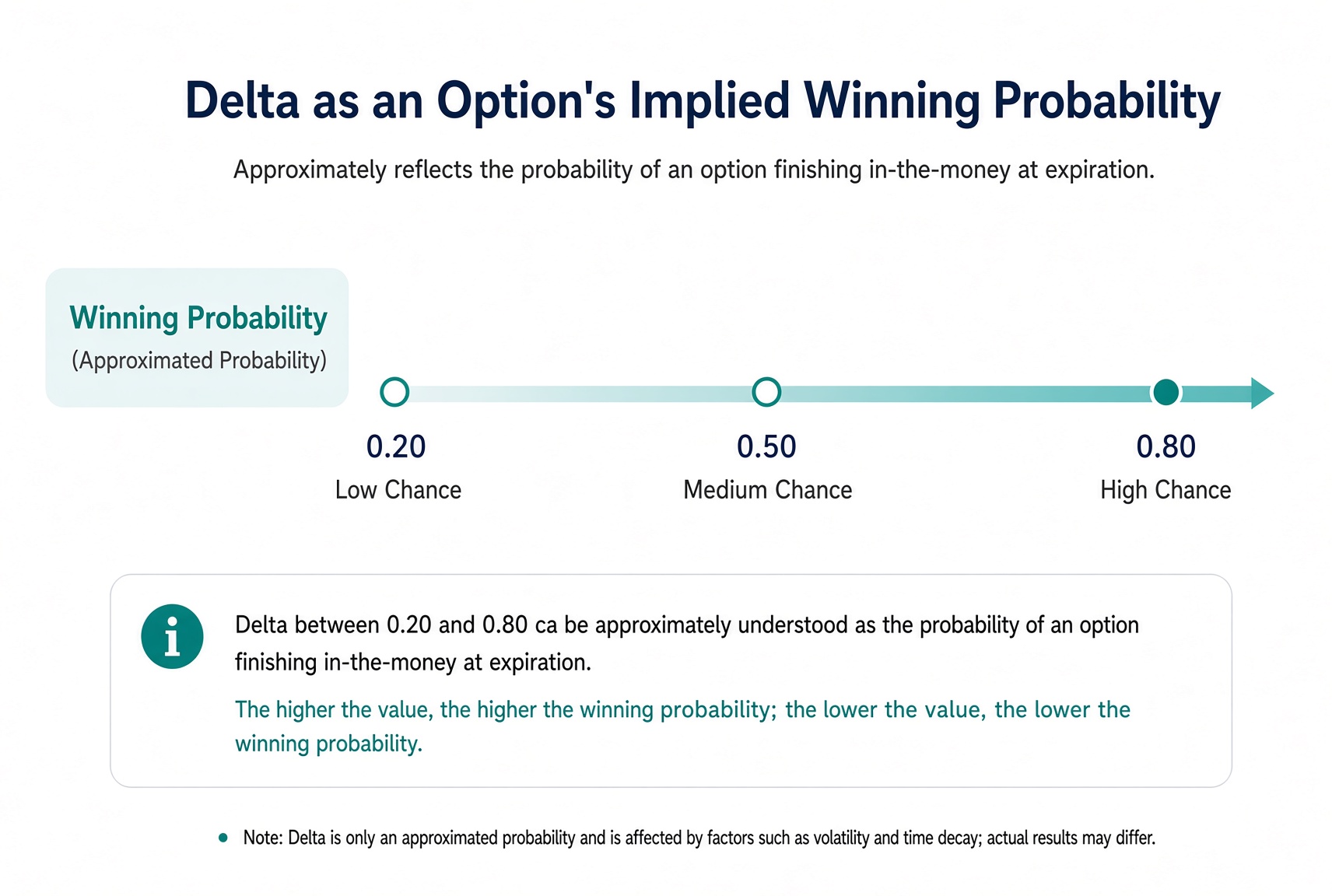
For example:
A Call with Delta 0.70 has about a 70% chance of still having intrinsic value at expiry.
A Call with Delta 0.30 has about a 30% chance of finishing ITM.
Around Delta 0.50, it is close to a coin flip.
That approximation is useful on the desk. When a beginner buys, they can look at Delta first and quickly see whether they are buying “high chance, expensive” or “low chance, cheap.”
Takeaway: Delta is not a forecast tool. It quantifies risk and probability. Look at it first, then pick the strike.
What different Deltas feel like
Split Delta by size and the contract’s temperament changes:
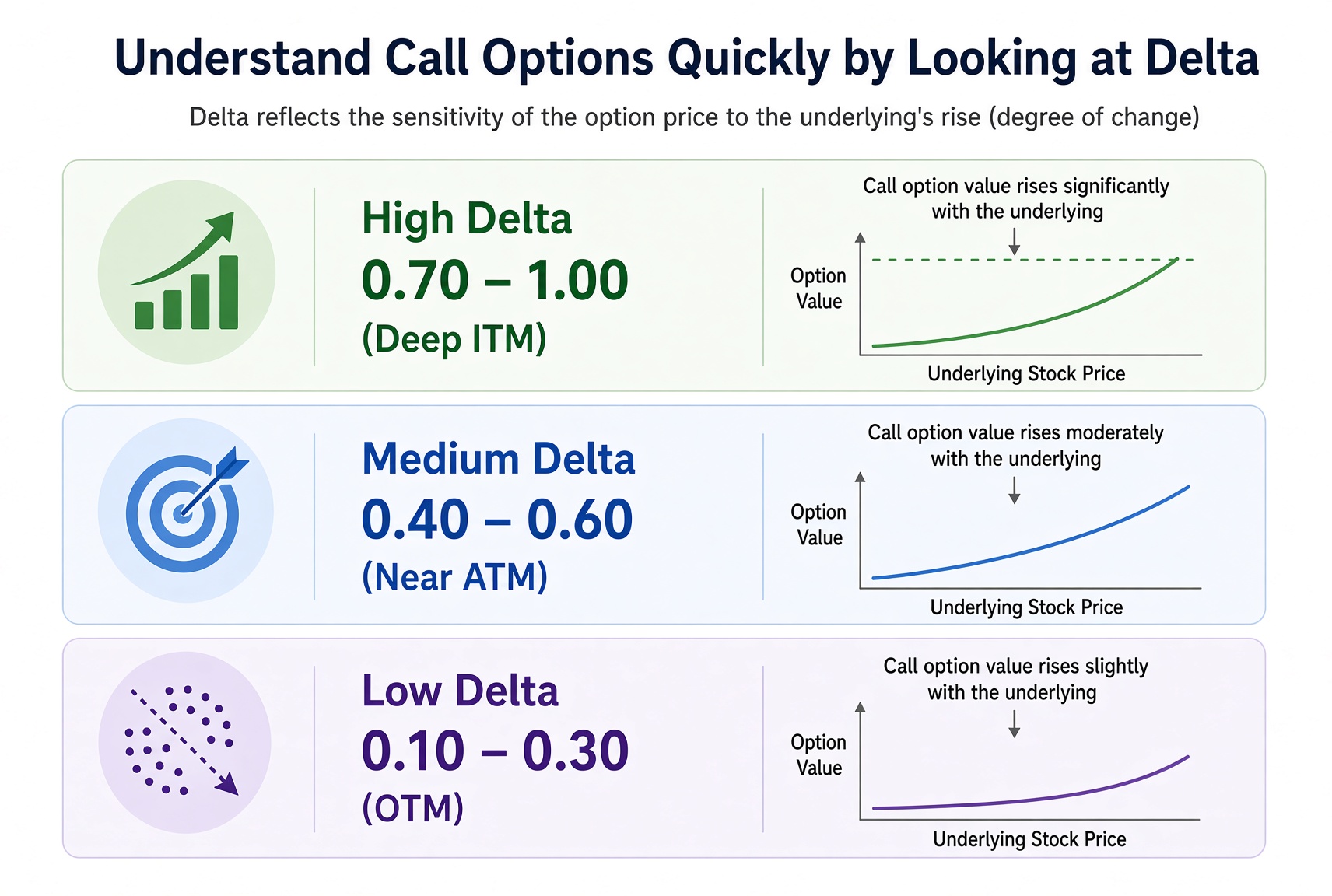
High Delta (0.70–1.00): deep ITM, behaves closer to the stock, less time value in the price.
Mid Delta (0.40–0.60): near at-the-money, more time value, a more balanced mix of leverage and risk.
Low Delta (0.10–0.30): out of the money, cheap, low win rate — close to a lottery ticket.
The beginner mistake is buying only the cheapest, lowest-Delta OTM options because “if it dies, I won’t mind.” Over time, those contracts go to zero a lot.
Takeaway: Low Delta is cheap because it is more like a lottery. Ask first whether you want win rate or payoff odds.
How buyers and sellers use Delta
Buyer: if you want a higher win rate, pick a higher-Delta contract. If you will trade a low win rate for a large payoff, pick a lower Delta — and a much smaller size.
Seller: selling high-Delta options means a higher chance of being exercised. Selling low-Delta options has a higher win rate, but less premium per contract.
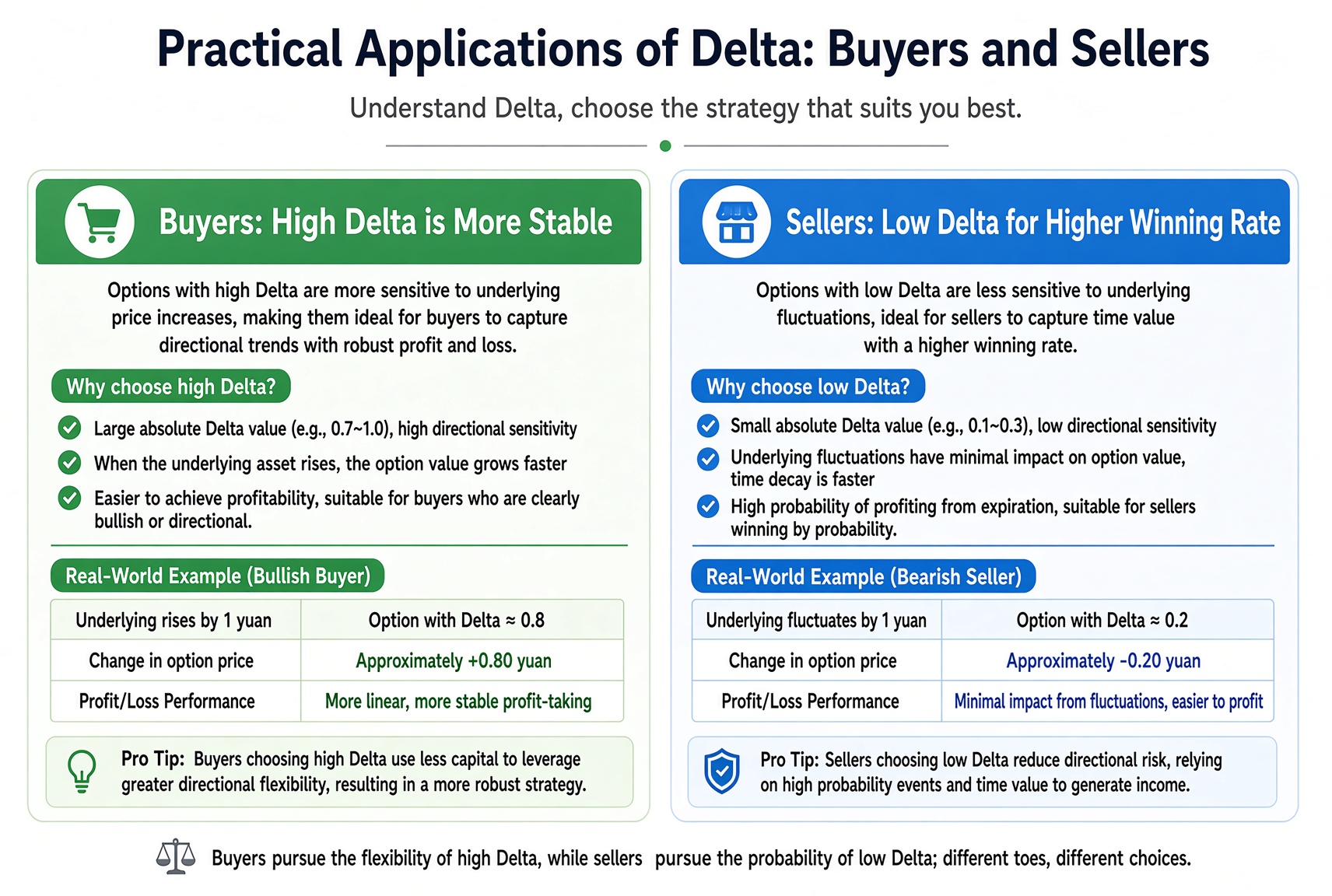
Takeaway: Using Delta to size the position and pick the contract beats staring at the premium number alone.
Wrap-up, next lesson on Theta
Delta has two everyday meanings: when the stock moves one dollar, how much the option roughly moves; and the rough chance this contract finishes in the money.
It will change. As the stock moves and time passes, Delta itself moves. Next we look at the number that eats premium every day: Theta.
Check these three first
Pass these three before the next lesson. You can skip.
1.Delta roughly says how the option price moves if the stock moves $1.
2.A Delta of 0.30 means this trade has a 30% chance of making money.
3.In the usual shortcut, Delta is closer to “still in the money at expiry,” not the chance you profit.