Gamma and how the Greeks work together
What you will learn
See Gamma as Delta’s acceleration, and stay away from high-Gamma risk near expiry — especially 0DTE
What Gamma is
Delta changes, Theta eats, Vega answers to volatility. Gamma measures how fast Delta itself changes.
Gamma measures: for each $1 the stock moves, roughly how much Delta changes. It is Delta’s “acceleration.”
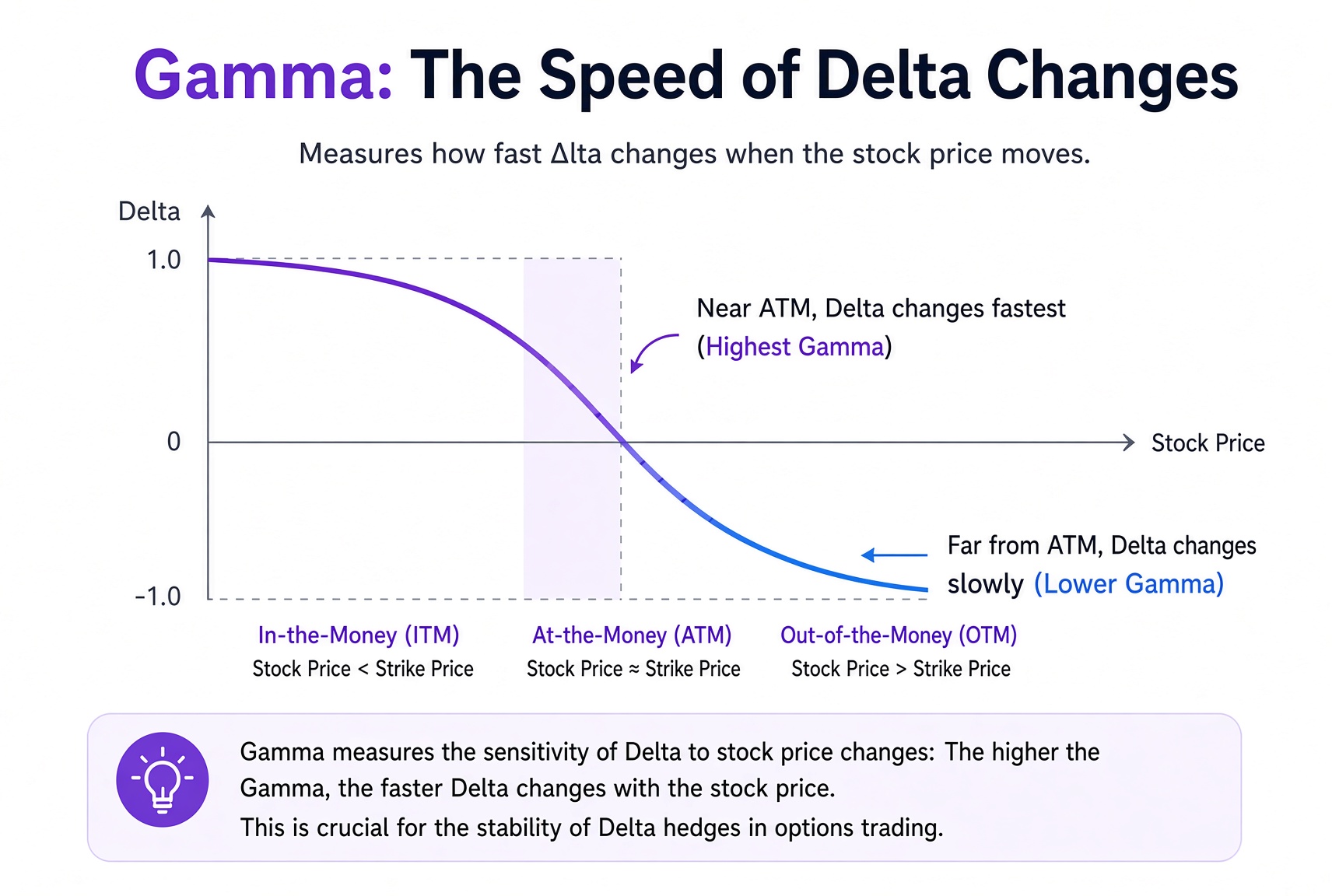
At-the-money options usually have the highest Gamma, because that is where Delta changes fastest. Deep ITM or deep OTM options have lower Gamma.
Takeaway: High Gamma means Delta changes fast, so the option’s sensitivity to the stock can flip quickly.
Why 0DTE and near-expiry are especially dangerous
As expiry nears, Gamma on at-the-money options gets very high. A small stock move can swing Delta hard, and the option can spike or crash.
That is why 0DTE (same-day expiry) options whip around so much, and why beginners lose control so easily.
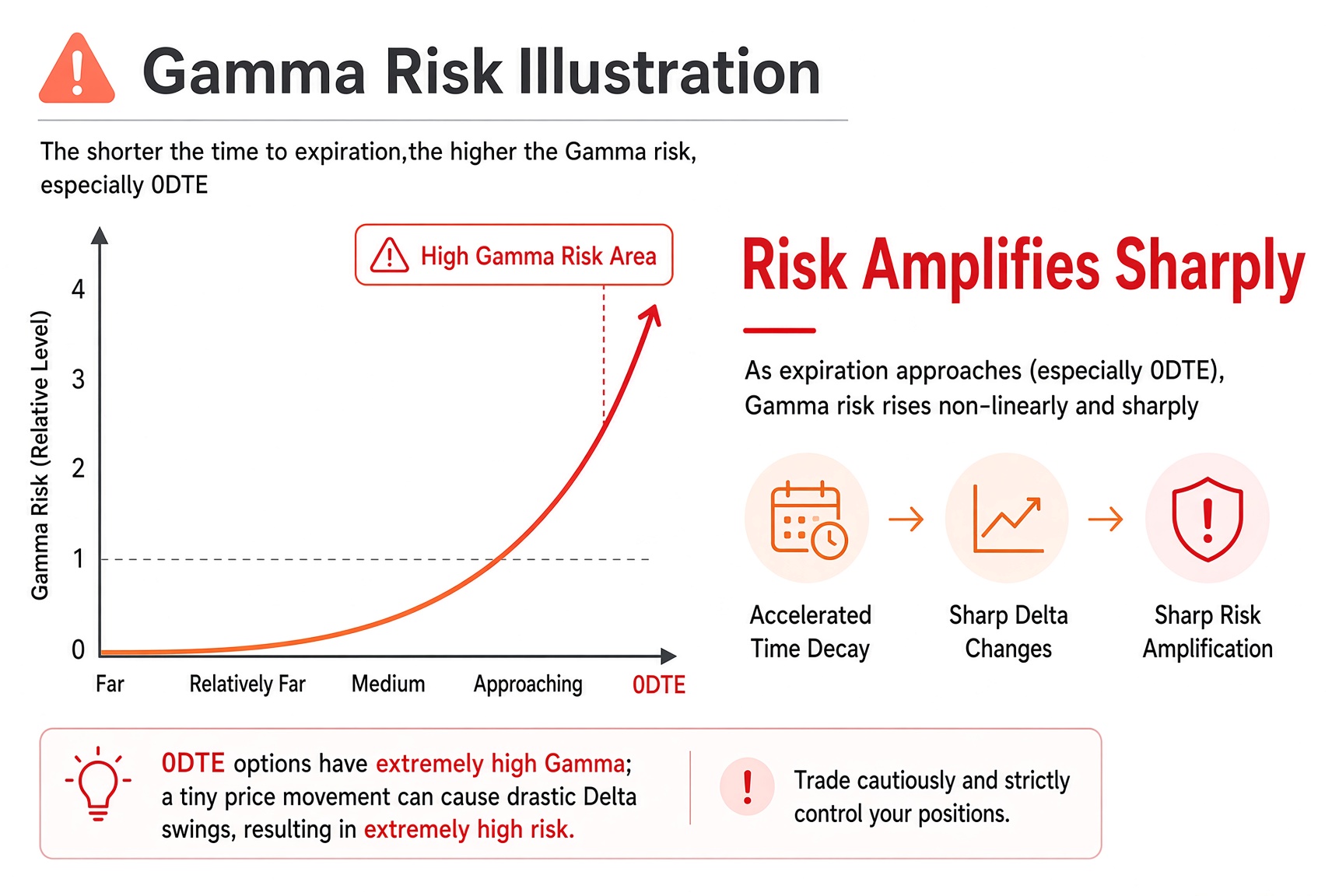
Takeaway: The closer to expiry — especially same-day expiry — the sharper Gamma risk gets. Beginners should mostly stay away.
The Greeks as one picture
In a live trade these letters are not isolated:
The stock moves → Delta is affected, and Gamma sets how fast Delta changes.
Time passes → Theta is affected, and Gamma and Vega shift too.
Volatility changes → Vega is affected, and the option price changes with it.
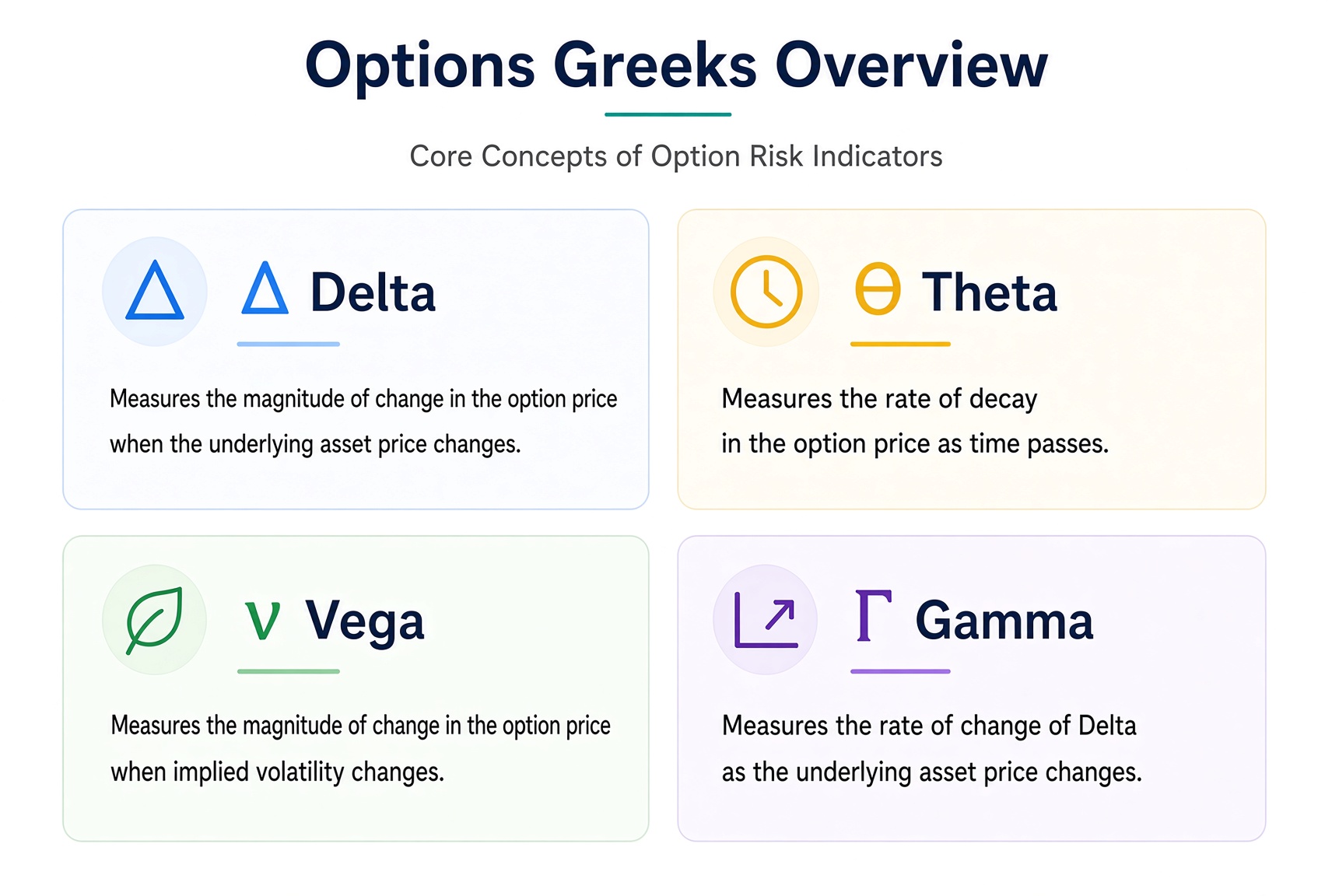
Understanding options means treating them as a system, not a single number.
Takeaway: Delta, Theta, Vega, and Gamma each measure one dimension. Walking through all four before you open a trade beats staring at the stock alone.
Practical notes for beginners
Master Delta and Theta first — they are the most intuitive.
Once Vega is clear, then touch trades around earnings.
High-Gamma contracts (especially at-the-money near expiry) carry a lot of risk. Beginners should mostly avoid them.
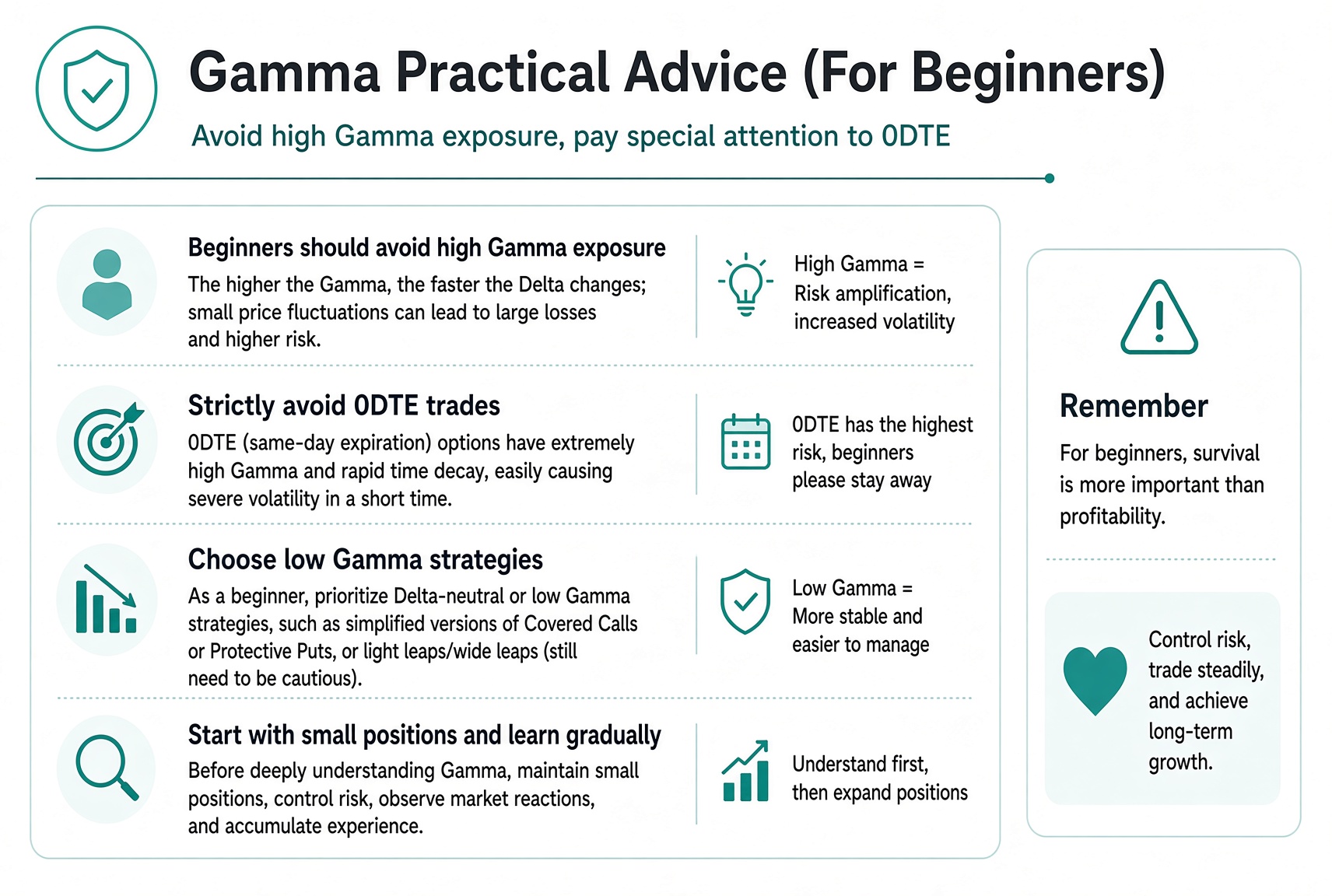
Takeaway: The Greeks are risk tools, not forecast tools. Use them to read risk and size, not to “guess” the market.
Wrap-up, next lesson picks expiry and strike
The first eight lessons stand up the contract, the chain, pricing, and the four main Greeks. Gamma is Delta’s acceleration; near expiry — especially same-day expiry — that acceleration gets dangerous.
Whatever structure you run next, two practical questions always show up: how far is expiry, and which strike? The next lesson gives a set of rules you can actually run.
Check these three first
Pass these three before the next lesson. You can skip.
1.Gamma measures how fast Delta itself changes.
2.Near expiry — especially same-day expiry — Gamma usually gets milder.
3.Before you open a trade, look at Delta, Theta, Vega and Gamma on the same risk sheet.